
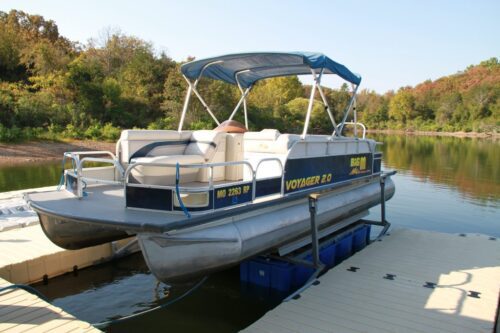
Owning a boat brings a unique sense of freedom — the ability to explore, fish or relax whenever the mood strikes. But, to protect your vessel, you should give careful consideration to investing in a reliable boat lift to keep your hull above the waterline when not in use.
This protects it from algae growth, electrolysis and wave damage, while also making it faster and easier to launch when you head out on the water for relaxation or adventure.
So, let’s take a look at the best boat lifts and how to decide which one fits your needs.
Best Boat Lifts (The Top 5)
Five leading manufacturers of boat lifts each have distinctive strengths, catering to different vessel needs and environments.
1. EZ Dock
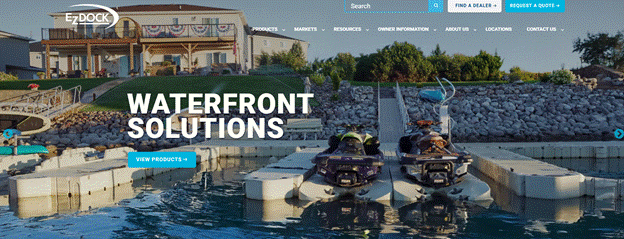
EZ Dock has long been a pioneer in modular floating docks and personal watercraft (PWC) ports, and its boat lifts reflect the same focus on durability and simplicity. The Aegis™ Boat Lift is an air-assist flotation design that can handle vessels up to around 7,000 pounds and 28 feet in length. The polyethylene flotation tanks and galvanized steel framework resist corrosion, with optional solar or electric pumps ensuring smooth and low-maintenance operation.
EZ Dock also offers the EZ BoatPort — a drive-on, floating platform, ideal for small boats and PWCs. Both options integrate perfectly with its modular dock systems, allowing for a unified, custom layout.
Key features:
| Air-assist flotation lift up to 7,000 pounds | Drive-on BoatPort solutions for PWCs and small craft |
| Durable polyethylene tanks and UHMW bearing surfaces | Modular compatibility with EZ Dock’s full line |
Red hot fishing shirts from N1 Outdoors®
-
Put a Hook N1™ UPF 50+ Redfish Performance Fishing Shirt
$15.00 -
N1 Outdoors® Fishscape™ Outdoor Tee
Price range: $28.99 through $32.99 -
N1 Outdoors® FISH. Performance UPF 50+ Shirt
Price range: $37.99 through $39.99

2. ShoreMaster
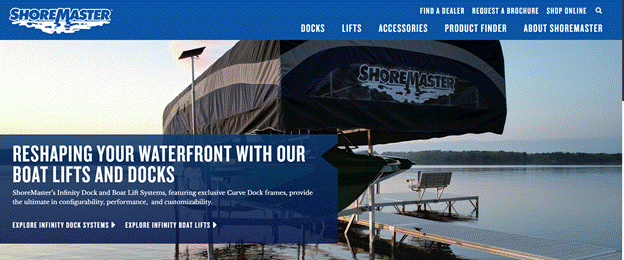
ShoreMaster is known for high-quality aluminum products that are built for longevity. Its product range includes vertical, hydraulic, pontoon lifts and PWC lifts, all designed with welded aluminum frames for strength and minimal corrosion. Its vertical lifts offer 66-inch rack travel and are designed to allow easy access to boats from both sides.
Shoremaster emphasizes simple ownership with features like quiet winch operation, interchangeable motor systems, and broad accessory options such as canopy covers and guide-ons.
Key features:
| Welded aluminum frame construction | Vertical, hydraulic and pontoon lifts |
| Extensive accessory catalog | Large dealer network |

3. ShoreStation
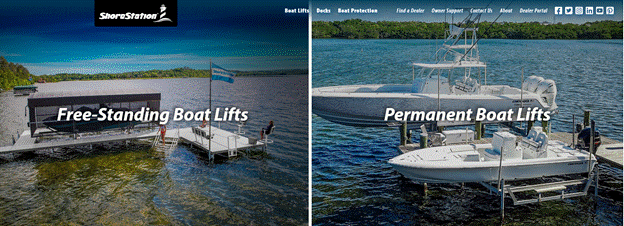
ShoreStation has been in the boat lift industry for decades and is especially known for its freestanding hydraulic systems. These lifts operate quickly and reliably, with hydraulic and electrical components positioned above the waterline to reduce maintenance. They can be powered by traditional AC, DC or solar sources, making them adaptable for remote docks.
ShoreStation’s freestanding lifts offer innovative covers, wireless operation and built-in safeguards against failure, including measures to eliminate cable fatigue. Guides make it easy to land even in poor conditions.
Key features:
| Above-water hydraulics | Fast lift and launch operation |
| Solar or AC/DC power options | Simple seasonal maintenance |

4. Dolphin Boat Lifts
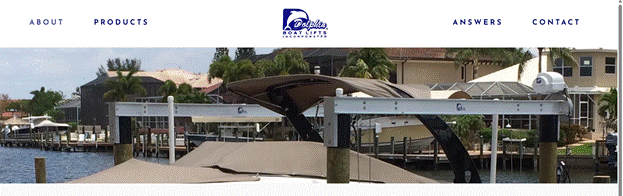
Dolphin Boat Lifts is based in Fort Myers, Florida, where it designs and fabricates systems for a wide variety of craft, from small runabouts to large offshore boats. It specializes in in-house production, custom fabrication and rapid access to replacement parts. The company’s Florida roots ensure its products are built with saltwater corrosion in mind.
Dolphin’s vertical cradle lifts have capacities up to 50,000 pounds, made from galvanized steel, aluminum or hybrid options. It also offers boathouse and marine elevator solutions for situations where the site or space makes a vertical option impossible.
Key features:
| Custom-built lifts | Quick access to parts |
| Wide range of capacities | Freshwater and saltwater applications |
5. Sea-Legs
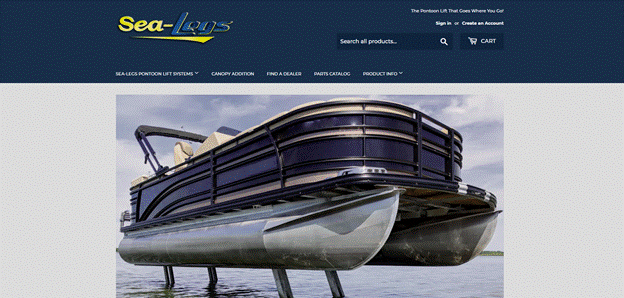
Sea-Legs is a specialist in pontoon-specific lift systems. Instead of relying on cables or cradles, these utilize hydraulically powered legs attached to the underdeck of the craft. The legs raise the pontoon directly out of the water. It’s an innovative design for variable lake bottoms or shallow shorelines. Sea-Legs offers twin- and triple-tube models and publishes detailed installation guides.
Sizing is easy, and a twin-tube model has nearly 7,000 pounds of lifting capacity, running off the outboard motor. The legs require minimal maintenance or winterizing. An optional canopy is also available.
Key features:
| Hydraulic leg-and-pad system for pontoons | Twin and triple models available |
| Designed for soft-bottom lakes | Reliable hydraulic operation |

Comparing the Best Boat Lifts
Featured companies were selected based on customer support and industry reputation, as well as innovation and product features. Product quality and materials were examined, and warranties were also taken into consideration.
Depending on your vessel, location and unique needs, one or more of the top boat lift companies likely have what you require. Here is a quick summary of what they offer.
| Company | Lift Types | Typical Capacity | Power Options | Best Use |
| EZ Dock | Air-assist flotation, drive-on ports | Up to 7,000 pounds | Electric or solar | Modular docks, small to midsize boats |
| ShoreMaster | Vertical, hydraulic, pontoon | Up to 15,000 pounds | Electric | Aluminum-frame lifts for residential use |
| ShoreStation | Freestanding, hydraulic | Up to 15,000 pounds | AC, DC or solar | Quick hydraulic operation |
| Dolphin Boat Lifts | Cable, hydraulic, custom-built | Up to 50,000 pounds | Electric or hydraulic | Custom fabrication and saltwater use |
| Sea-Legs | Pontoon leg lift | Up to 7,000 pounds | Hydraulic | Pontoon and tritoon vessels |
How Boat Lifts Work
At the simplest level, boat lifts serve the same purpose — to raise and secure your craft above water. However, the underlying mechanisms vary significantly.
- Cable: These rely on mechanical winches and pulleys to pull the cradle upward, either manually or via an electric motor.
- Hydraulic: This option substitutes cables for pistons and pumps, creating smoother and faster movement.
- Air-assist: Buoyancy inflates or deflates sealed tanks to raise or lower the boat.
- Pontoon-leg: This allows you to raise the vessel directly using built-in hydraulic legs.
- Drive-on ports: The boat drives onto a floating dock section.
Pros and Cons of Different Types of Boat Lifts
A comparison of the main types reveals their respective strengths and weaknesses.
| Lift Type | Advantages | Limitations |
| Vertical Cable or Winch | Reliable, simple design that works for various hull types | Requires pilings or frame anchoring Metal parts may corrode |
| Hydraulic Freestanding | Fast and smooth operation, ideal for various depths Little physical effort required | More expensive Hydraulic systems require servicing |
| Flotation or Air-Assist | Corrosion-resistant and gentle on hulls Integrates with modular docks | Limited capacity Pump systems require maintenance |
| Pontoon-Leg | Ideal for pontoons Works on soft or uneven bottoms. | Not suitable for V-hull boats Specialized use only |
| Drive-on Port | Easiest operation and lowest maintenance | Limited to smaller craft Unsuitable for heavy boats |

What Are the Best Boat Lifts for Your Needs?
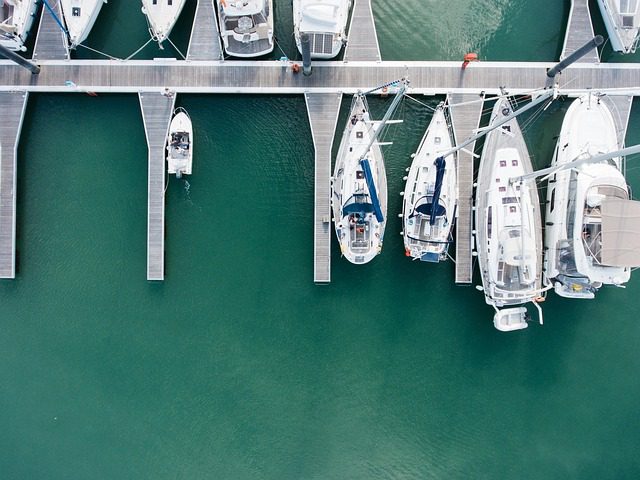
Your boat is a valuable investment, so be sure to follow the below procedures to choose the correct boat lift.
1. Assess Your Craft
Start with accurate numbers, including your vessel’s dry weight, plus the weight of fuel, gear and passengers. You must also consider its length, beam and hull design. Always choose a product with at least a 15%-20% safety margin above that total.
2. Evaluate Your Waterfront
Measure the depth at both high and low water and note whether your lake or bay has a firm or soft bottom. Certain lifts, like vertical or piling-mounted ones, need solid anchoring, while hydraulic and pontoon options can adapt to softer sediments.
3. Consider Power Sources and Convenience
If you have AC power at your dock, electric lifts are straightforward. Otherwise, solar or battery-driven systems are better choices, especially for remote or off-grid properties.
4. Think About Corrosion Resistance
Saltwater and brackish environments are tough on steel components. Opt for aluminum or polymer to minimize corrosion issues.
5. Evaluate Dealer and Service Support
Even the best boat lifts can fail without proper installation or maintenance. Choose a manufacturer with a strong dealer network and an available parts inventory, so if something goes wrong, it can be quickly addressed.
Installation and Permitting for Boat Lifts

Installing a vessel lift isn’t as simple as setting it in the water and flipping a switch. Local permitting rules often apply to shoreline construction, especially for permanent pilings or hydraulic systems. Homeowners on regulated lakes may need to submit drawings or apply for environmental clearance before installation begins. It is critical to check with your local zoning board or conservation authority before purchasing, as their rules may influence your decision.
Professional installation is highly recommended. Even modular lifts benefit from experienced setup to ensure correct leveling, pump calibration and anchoring. Electrical safety also plays a role. Lifts powered by shore AC should be protected by ground-fault interrupters and marine-grade wiring.
Finally, consider seasonal changes. In northern climates, freestanding lifts may need removal or winter positioning to avoid ice damage. Floating systems are generally more forgiving but still require inspection before freezing conditions.
Boat Lift Maintenance and Longevity
A well-maintained boat lift can last decades. While materials like aluminum and polyethylene require minimal care, mechanical components still need attention.

Careful inspection and maintenance of your boat is time and money well-spent!
Inspect cables annually for fraying or rust. Replace them before failure, not after. Winches and pulleys should be greased according to the manufacturer’s recommendations. Check hydraulic lift hoses for leaks and top off fluid levels as needed.
Flotation options are largely maintenance-free, but pumps and valves should be cleaned and drained seasonally. Always rinse your lift with fresh water if it’s used in saltwater, and remove any barnacle or algae buildup that could affect its movement.
Keeping a log, even if just notes on your phone, helps you stay ahead of wear and tear issues that could shorten your lift’s lifespan.
How Much Do Boat Lifts Cost?
Boat lifts can be a significant investment, although the actual cost depends on the type, capacity and power source. Entry-level drive-on ports are the most affordable, while hydraulic and custom lifts command higher prices.
Aluminum lifts tend to fall in the midrange, balancing cost and longevity. Hydraulic options may cost more initially, but they often provide better resale value due to their speed and ease of use. If you live on the coast, investing in marine-grade aluminum or stainless steel hardware will save you money in the long run by avoiding corrosion-related replacements.
Installation, permits and electrical work can add significantly to the total price, so always request a detailed, written quote from your dealer.
Accessories That Add Value
Beyond the lift itself, a few items can dramatically improve convenience and give your boat a, well… lift!
Canopy covers protect craft from UV exposure and debris, while guide posts make docking smoother, especially in windy conditions.
Remote controls are another upgrade worth considering. These allow you to raise or lower your lift with a button press from inside the boat. For off-grid docks, solar charging systems can keep your DC or hydraulic setup running reliably without requiring shore power.
Finally, lighting kits and maintenance walkways are small investments that greatly enhance safety and usability, especially at night.
Preparing Your Boat Lift for Winter or Storms
Just as you follow guidelines to winterize your vessel, you also need to take care of the lift. Inspect and tighten all hardware, remove canopies and drain hydraulic lines before freezing weather arrives.
For floating or air-assisted systems, ensure tanks are fully drained to prevent damage from freezing-induced expansion. In storm-prone coastal areas, remove or secure motors, pumps, and electrical components ahead of hurricanes or high winds. Many manufacturers provide seasonal care checklists — following these can add years to your lift’s life.
Frequently Asked Questions About Boat Lifts

While considering this investment, you may have many questions. Your chosen dealers are the best resource for answers, but here are some of the more commonly raised issues.
Q: Can Any Dock Support a Boat Lift?
A: Not necessarily. Some integrate directly with modular docks, while others require dedicated pilings or freestanding frames. Always check compatibility with your dock type.
Q: Are Hydraulic Boat Lifts Worth the Higher Cost?
A: If convenience, speed and minimal manual effort are important to you, hydraulic boat lifts might be worth the expense. It is a matter of preference, but for heavier boats especially, the low-effort operation of a hydraulic system can justify the investment.
Q: Do I Need Professional Maintenance for My Boat Lift?
A: Many owners handle basic and seasonal care themselves, but annual professional inspections are always wise. This is especially true for hydraulic or electrical systems where leaks or wiring faults may not be immediately obvious.
Protecting Your Floating Pride and Joy
Choosing the best boat lift is a significant decision that protects your vessel and enhances your time on the water. By assessing your craft’s specifications, understanding your waterfront conditions, and considering power and material options, you can narrow down the choices.
The leading manufacturers all offer quality solutions for different needs. Ask reputable dealers informed questions and select a boat lift that will provide security and convenience for years to come.
Now, get out there on the water and safe boating!