
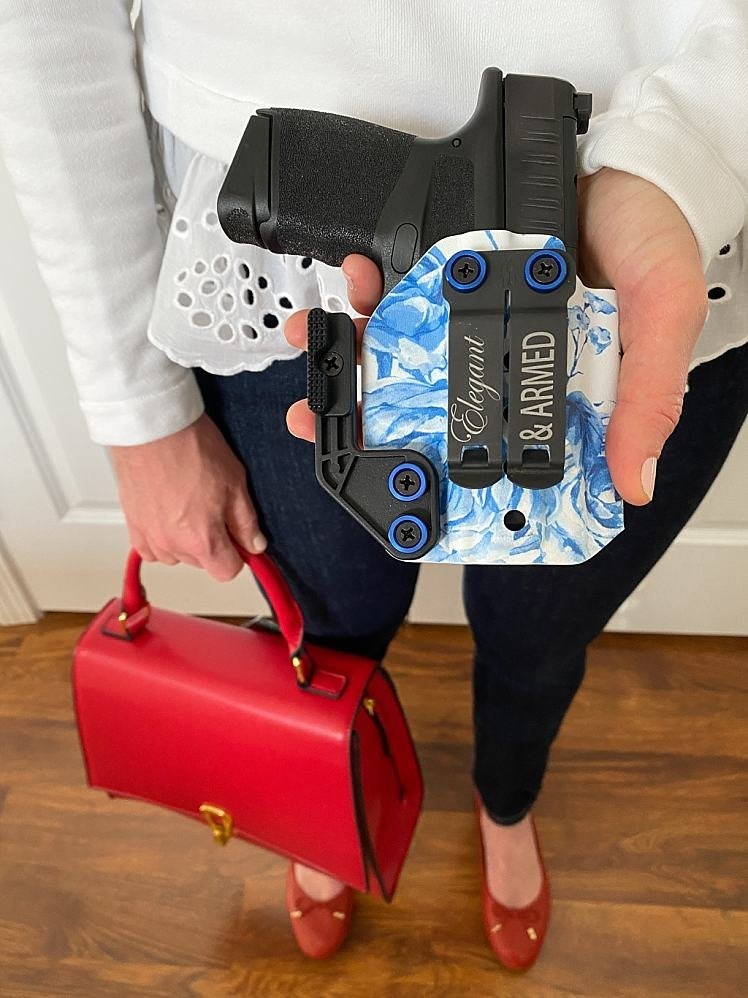
When it comes to concealed carry options for women, there tends to be an initial problem… belt loops.
Here’s why…
A good share of women’s jeans have thin, decorative loops or none at all, and leggings don’t have them either, So, then maybe you opt for the standard clip-on holster sold at the gun counter. Before long, it’s sagging, tipping outward, or sliding around. Plus, hip flare, in addition to a waistline that sits higher than the pants only makes it worse.
Start With Your Body and Your Clothes, Not the Gun
Women often have a shorter torso and more hip flare than men do, and the natural waist tends to sit a few inches above where the pants actually ride. That space between waist and belt line is the reason a pistol on the strong-side hip so often tilts its grip out and prints, or pokes into the ribs whenever you sit down in a chair or a truck seat.
That’s why it’s worth standing in front of a mirror in your normal clothes before spending money.
Think about whether you wear a sturdy belt most days, or whether you’d need a holster built to work without one. Then, notice how high the rise is on the jeans you would typically wear, because high-rise pants and leggings move the whole picture up.
Then, look at your tops, since a fitted tee will show the outline of nearly any pistol, while a loose flannel or a hunting jacket does a better job of concealing. And, give some serious thought to how much of the day you spend sitting (at a desk, in the cab of a truck, in a tree stand, etc), because sitting is usually where a poor holster choice shows itself.
The Main Carry Positions
Now, let’s take a look at the typical carry positions…
AIWB (Appendix Inside the Waist Band)
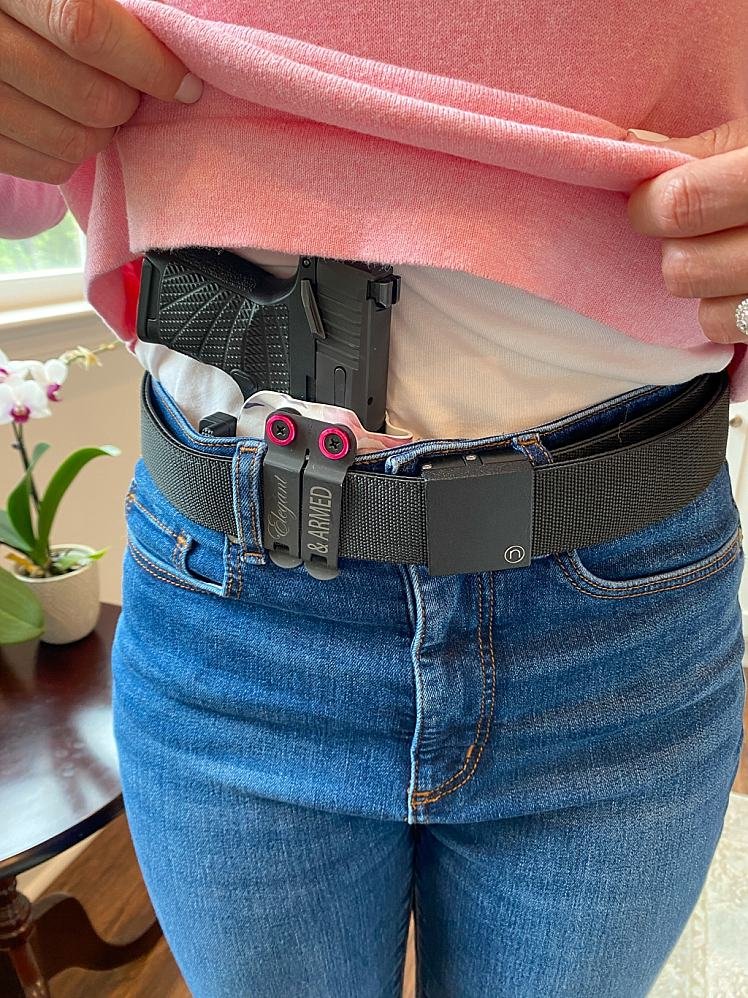
Appendix carry places the gun inside the waistband somewhere between the belly button and the strong-side hip bone, and a lot of women end up here on holster choice because it mostly avoids the hip flare issue altogether, and a loose top over it conceals a compact pistol pretty well.
There are tradeoffs, or cons of the AIWB holster type, though.
Sitting for long stretches with a full-size pistol in front can get uncomfortable, and the muzzle is pointed toward the femoral artery during reholstering. So, look for a holster with a claw or wing that pushes the grip in toward the body, plus full trigger guard coverage. And, be sure to reholster slowly while looking at the holster, with your shirt held clear of it.
Strong-Side Hip (3 to 5 O’Clock)
The traditional belt position does work for some women. Typically, it’s those with a straighter hip line, and who wear a stiff gun belt. A forward cant — meaning the grip tilts toward the front — tends to help quite a bit. Ride height is a bigger deal than people expect, since a gun riding high will jab the ribs, while one riding low will dig into the hip.
Plenty of shoppers start by looking at concealed carry holsters for women with adjustable cant and ride height, then set them up at home in their own clothes until the grip stops printing.
We looked at the body shape and holster fit from a different angle in Best Concealed Gun Holsters for Fat Guys, and much of the thinking there about wider backing plates and adjustable clips applies here as well.
You should check out ALL our hunting, fishing and outdoor tees!
-
N1 Outdoors® Fishscape™ Outdoor Tee
Price range: $28.99 through $32.99 -
The “Outdoors All N1™” Hand Illustration Tee
Price range: $24.99 through $28.99 -
N1 Outdoors® Whitetail Sugar Skull Tee (Black/Columbia Blue)
$19.00
Cross-Draw and Shoulder Rigs
With cross-draw holsters, the gun rides on the off side with the butt facing forward. People who drive a lot, or who sit in a blind for hours, tend to like it because the grip stays reachable while seated and buckled in.
Chest rigs and shoulder holsters do something similar under a coat, and hunters who carry a sidearm for bear or hogs often use them since they stay out of the way of a pack’s hip belt. The drawback is that the muzzle sweeps across anyone beside you on the draw, so this position requires a good bit of careful dry practice. Safety is paramount!
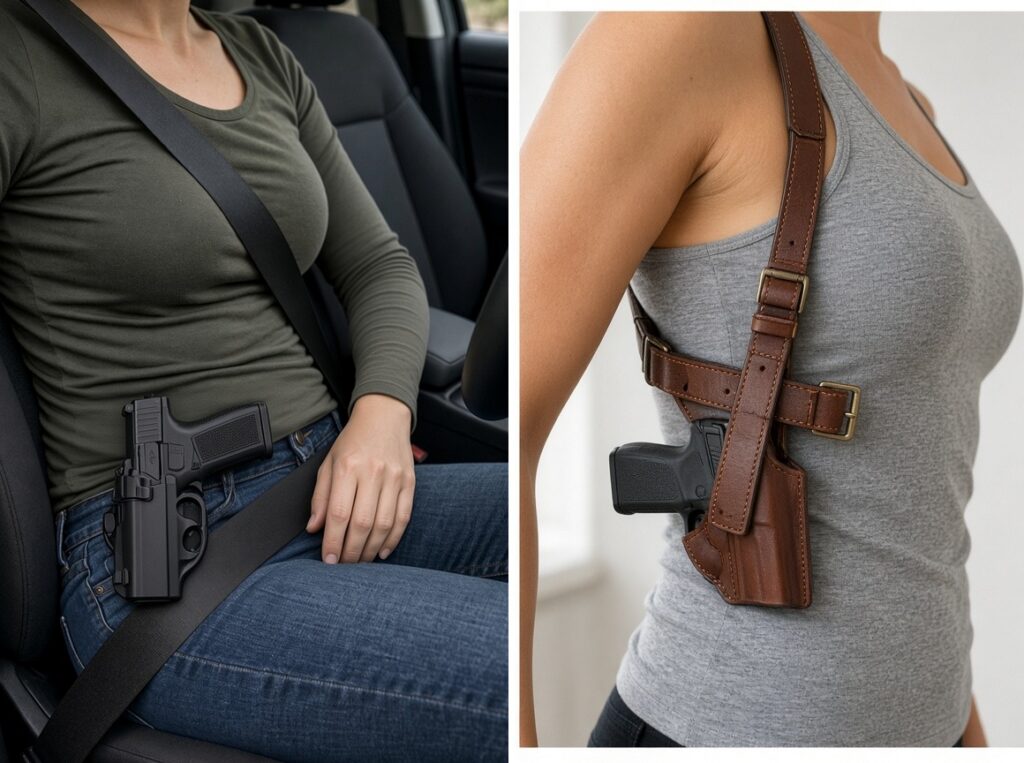
Cross-Draw and shoulder rigs keep the gun away from any hip pack, but they also place the gun sweep across anyone that may be beside you on the draw.
Deep Concealment: Belly Bands, Corset and Bra Holsters
These specific gun holster types are for dresses, gym clothes, and other outfits that don’t have a usable waistband.
A belly band holster is basically an elastic wrap with a pocket sewn in, and it can hold a small pistol at nearly any spot around the torso. Most traditional holsters clip directly onto a heavy, rigid belt. But, a belly band holster is independently of your clothing, and relies on its own compression and a hook-and-loop closure to remain securely in place.
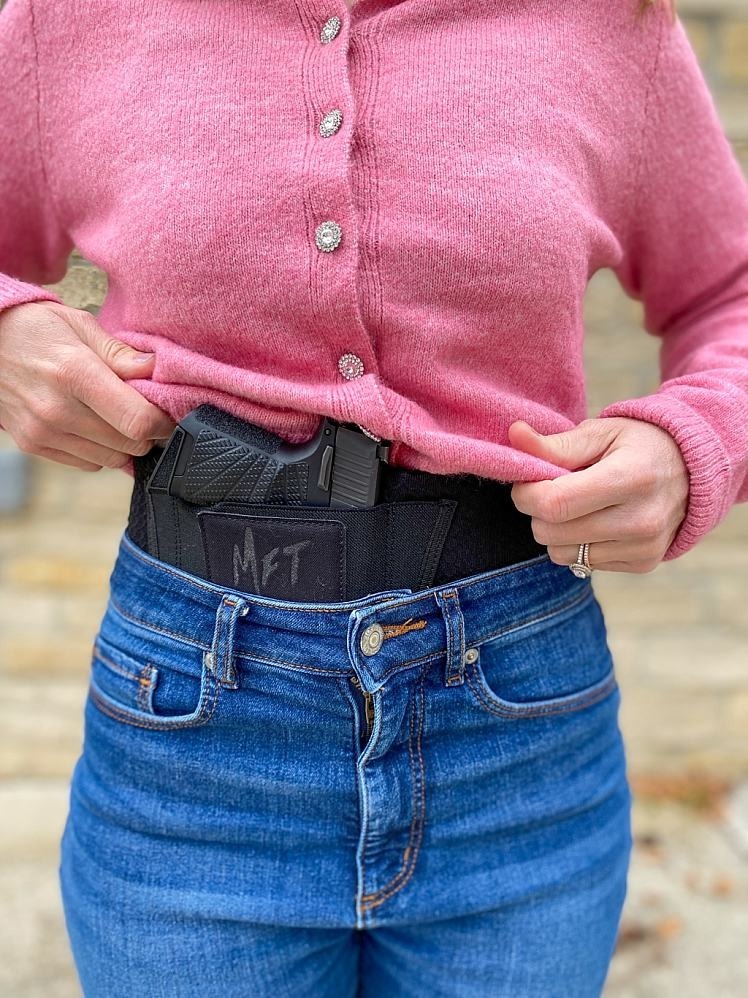
Belly band holsters rely on compression and and some type of fastener, like velcro, as a closure.
A corset holster typically has a much wider vertical profile, that spans from just under the bust down over the hips. It uses hook-and-eye rows or heavy-duty zippers to compress your midsection, with built-in fabric pouches angled along the torso to secure your firearm.
A bra holster mounts your firearm directly onto your brassiere, using the support panel or the underwire area as its main anchor point, and it isolates your firearm to your bra fame. This allows you to carry while wearing shirts, dresses or crop tops that expose the waist entirely.
Drawing from any of these types of holsters is slower, and sometimes requires you to use both hands. You may even have to utilize a firm pull from under a hem, which can cause stretching. They make good options for those days when no other holster types seem to fit. If you use this type of holster, be sure to choose one that covers the trigger guard with something stiffer than cloth.
Off-Body: Purses and Packs
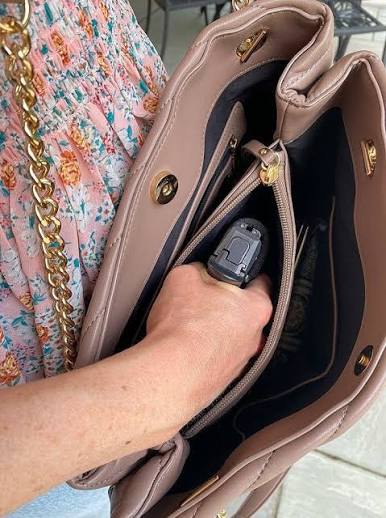
Carrying in a purse or pocketbook is common, and it’s also the method instructors tend to worry about most, because bags get put down, grabbed, hung over chair backs, and rummaged through by kids. So, if you choose to carry this way, be sure to use a purse that has a dedicated gun compartment with an actual holster, that is separate from the main purse compartment. And, be sure to keep the strap on your body, and not let the purse get out of arm’s reach.
Picking the Pistol Itself
When it comes to pistol choice, smaller isn’t always better.
Very small pocket pistols have a short sight radius, sharp recoil, and stiff slide springs that some shooters have trouble racking, while a compact 9mm around the size of a Glock 19 or Sig P365 XL is usually easier to shoot well and not a great deal harder to conceal inside the waistband.
For anyone who struggles to rack a slide, Smith and Wesson designed its EZ line with that in mind. Whatever you settle on, get a holster made for that specific model, since universal holsters tend to fall short on retention and trigger coverage.
The Drawstroke and Practice
A carry setup isn’t much use without a smooth draw, and that comes from repetition. Dry fire only with an unloaded gun you’ve checked yourself, and keep ammunition out of the room entirely.
Break the draw down into steps:
- Clear the cover garment, either pulling the shirt up hard toward the sternum with the off hand or sweeping a jacket back with the strong hand.
- Take a full firing grip with the gun still holstered, so there’s no adjusting afterward.
- Pull straight up, rotate the muzzle toward the target, and bring the support hand in near the chest.
- Push out to full extension.
- Reholster slowly with eyes on the holster and your finger outside the trigger guard.
Short sessions of around ten clean reps a few times a week will generally do more than a single hurried range trip each month. After that, a class where you draw and fire live is worth the time, and the NRA’s firearm training site lets you search instructors and courses near you, including basic pistol and concealed carry.
Home Defense: Staging Versus Storage
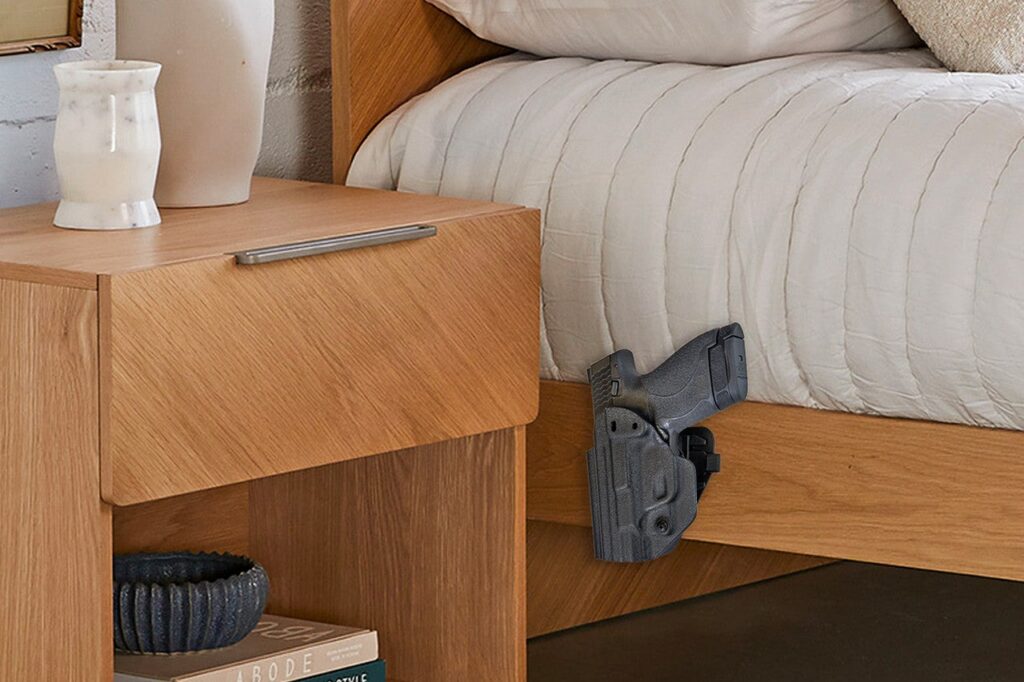
Some carriers want to have quick access, but keep firearms in a quick-access safe, as opposed to being accessible in plain sight.
Some women simply keep carrying at home, which means the gun is never sitting out anywhere. If that doesn’t fit your routine, choose one staging spot and plan around it.
A quick-access safe beside the bed — either biometric or a simplex keypad model — opens in a second or two, though it needs to be bolted down to prevent a burglar from simply carrying it off. Keeping the pistol in its holster inside the safe covers the trigger and lets you clip it on if you need it while moving through the house. Be sure to keep a light close by too (a weapon light, a handheld, or both), since you have to identify what you’re pointing at. Also, be sure to talk through a plan with the household about where everyone goes, who calls 911, and which room you hold, in the event of an emergency.
Backup guns, long guns, and hunting rifles all belong in a locked safe. Project ChildSafe, an NSSF program, offers a practical safe storage guide and distributes free cable locks through local law enforcement agencies. If you’re deciding between a pistol and a long gun for the house, our rundown of the best home defense shotguns is worth a look.

Check the Law Before You Carry Anywhere
Carry laws differ a lot between states, ranging from permitless carry to permits that are difficult to obtain. Rules about vehicles, state parks, and carrying while hunting also vary, and some states have storage laws that apply when minors live in the home. Read your state’s statute or attorney general page directly, and the NRA-ILA state gun laws pages make a reasonable starting point when you travel. Anyone carrying a sidearm on a hunt should also check the state wildlife agency’s regulations, because handgun rules during archery and muzzleloader seasons aren’t the same everywhere.
A Few Things to Check Before You Commit
A few more things to consider before selecting a women’s holster for home defense or everyday life: Make sure the holster is molded for your exact pistol and fully covers the trigger guard, and that you’ve got either a real gun belt or a holster designed for beltless clothing.
Do your dry practice from that same holster in the clothes you normally wear. Also, be sure to bolt down the bedside safe and lock up the rest, and read the carry and storage laws from the official source, as opposed to getting information from a forum thread.
Be sure to wear the holster for at least a full day before relying on it, running errands, sitting in the truck, and bending down to lace a boot, making sure to adjust anything that rubs or shifts.
Stay safe!