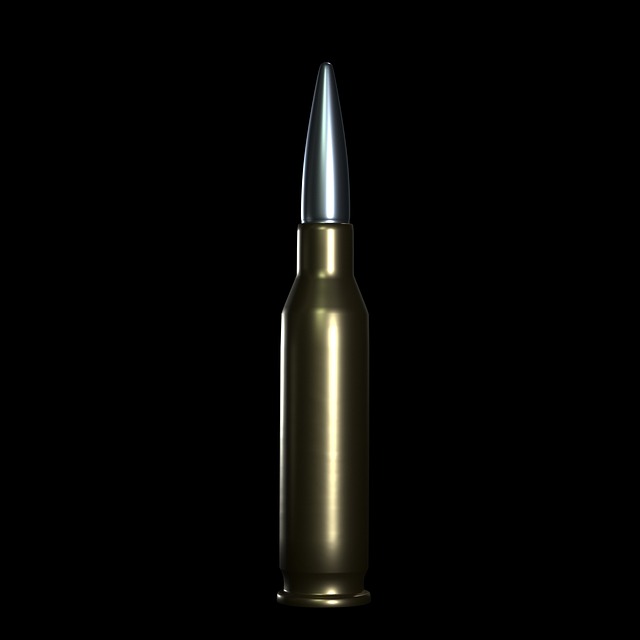
The method of gathering information for reloading ammunition has been gradually evolving. Reloaders once had to acquire information from several separate resources. However, now there are platforms that can act as a central hub of information, combining load reference data with ballistic analysis in a much more practical way, making the overall process more efficient and easier to manage.
The Good And Bad Of Reloading Data
Traditionally, most reloaders depended on published load manuals from powder and bullet manufacturers. These manuals provided tested charge ranges for specific cartridges and projectiles, giving shooters a reliable starting point when building loads safely.
While these references remain extremely useful, they also come with limitations. In many cases, manufacturers only include their own powders or bullets, which means reloaders must compare data from multiple sources when exploring different component combinations.
Alongside printed data, ballistic simulation software became another important part of modern handloading. Programs such as QuickLOAD allowed users to estimate internal ballistic behavior, including pressure and velocity, before assembling rounds. The rise of this type of software
added a deeper level of precision to load development, especially for experienced shooters trying to optimize performance. However, simulation tools generally require the user to already know which bullet, cartridge, and powder combination they want to test. Some of these older programs also struggle to keep pace with newer components because database updates have become less frequent over time.
Newer reloading platforms are beginning to merge these two systems into a more connected workflow.
Newer digital platforms combine ballistic calculators and analysis tools that allow for cross-referencing of multiple types of powder and bullet manufacturing data.
We earn a commission if you make a purchase, at no additional cost to you.
10/20/2026 03:45 am GMT
Instead of searching load tables first and then manually entering information into external software, reloaders can move between both steps inside the same environment. Platforms like ApexLOAD PRO are designed around this idea, offering access to extensive load data together with built-in ballistic calculators that can immediately analyze selected combinations.
In practice, this saves time and reduces unnecessary steps during load development. A reloader can quickly review compatible powders and bullets, evaluate possible combinations, and then refine the load for a particular rifle or performance target without constantly switching between different tools. For experienced handloaders, this creates a faster and more flexible workflow, while newer users benefit from a simpler introduction to ballistic analysis and load optimization.
For people of larger body types, finding the perfect concealed carry holster is an even bigger problem (no pun intended) than it is for others.
But, regardless of body type, there are some key things you need to consider when choosing a holster:
how comfortable is this holster?
Is it easy to access? (Will I have trouble drawing my firearm from it?)
Can I effectively hide it from view (thus, the term “concealed carry?”)
Unfortunately, most concealed carry holsters available today do little to help someone who has a larger frame that is trying to address the above considerations.
So, the goal of this article is to assist in making better choices when looking at a concealed carry holsters for larger framed individuals. We’ll provide helpful tips and recommendations for your best duty holsters, as well as what other options may work for you.
Addressing Unique Concealed Carry Challenges
Holster fit and function are influenced by body type, fashion choices, and daily activity. Carrying a firearm for personal protection, or as part of one’s job, requires having confidence in carrying it safely, out of sight, and with the ability to access it quickly, if needed.
Holster fit becomes extremely important with larger body types. The ability to access a firearm quickly and keep it concealed, all while staying comfortable is key.
Common problems experienced with holsters, especially those worn by larger persons, consist of the side being pressed upon by the holster; printing (the outline of the firearm visible through clothing); the holster moving around during normal movement, and difficulty in drawing the weapon rapidly if necessary. Not only do these situations cause discomfort, but can also create unsafe conditions. Thus, determining your individual requirements will be the first step in making an informed decision.
Priorities When Choosing a Holster
The most important characteristics for the best large duty holsters include:
Comfort: Duty holsters need to be comfortable enough so that they can be worn for extended periods.
Accessibility: It’s imperative to have a good method of drawing the gun out of the holster (quick and easy).
Retention: Safety comes first, which means you want your duty holster to have an effective retention mechanism so that it does not allow the gun to accidentally discharge when you’re not wanting it to or if someone else gets a hold of it.
Concealment: If you would like to conceal your firearm (wear it on your person), then you’ll need a holster that will help keep it from “printing” as much as possible and also remain concealed under all varieties of clothing.
Adjustability: As there are many different body types, adjustable features such as cant, ride height, and compatibility with belts will greatly enhance the ability to customize the fit of the holster to better match your needs.
Types of Concealed Carry Holsters to Consider
For bigger individuals, there are particular holster designs that tend to do well versus others. This is an overview of what experts would recommend you consider:
Inside The WaistBand (IWB) Holster Designs:
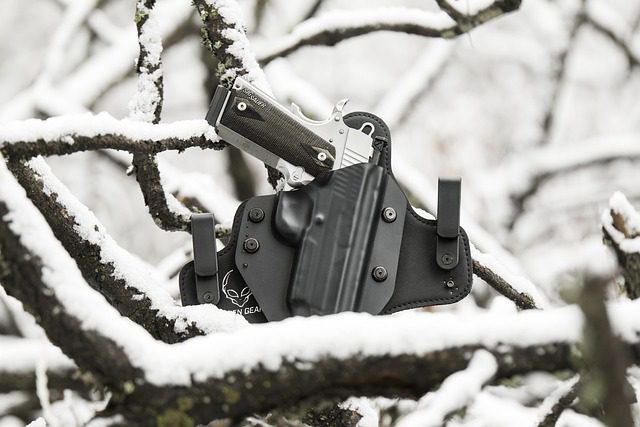
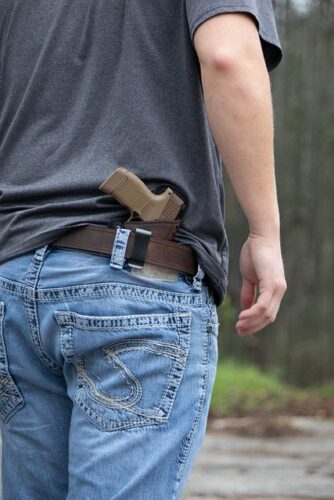
As the name suggests, Inside the WaistBand (IWB) holsters are typically worn inside your waistline, close to your body. For heavier people, it’s worth looking into IWB holsters with longer sweat guards and wider clips to help spread the weight so they don’t dig into your skin. Also, hybrid holsters have been shown to be great options because they use a combination of a rigid shell and either a leather or neoprene backing that provides both comfort and retention.
Outside The WaistBand (OWB)Holsters
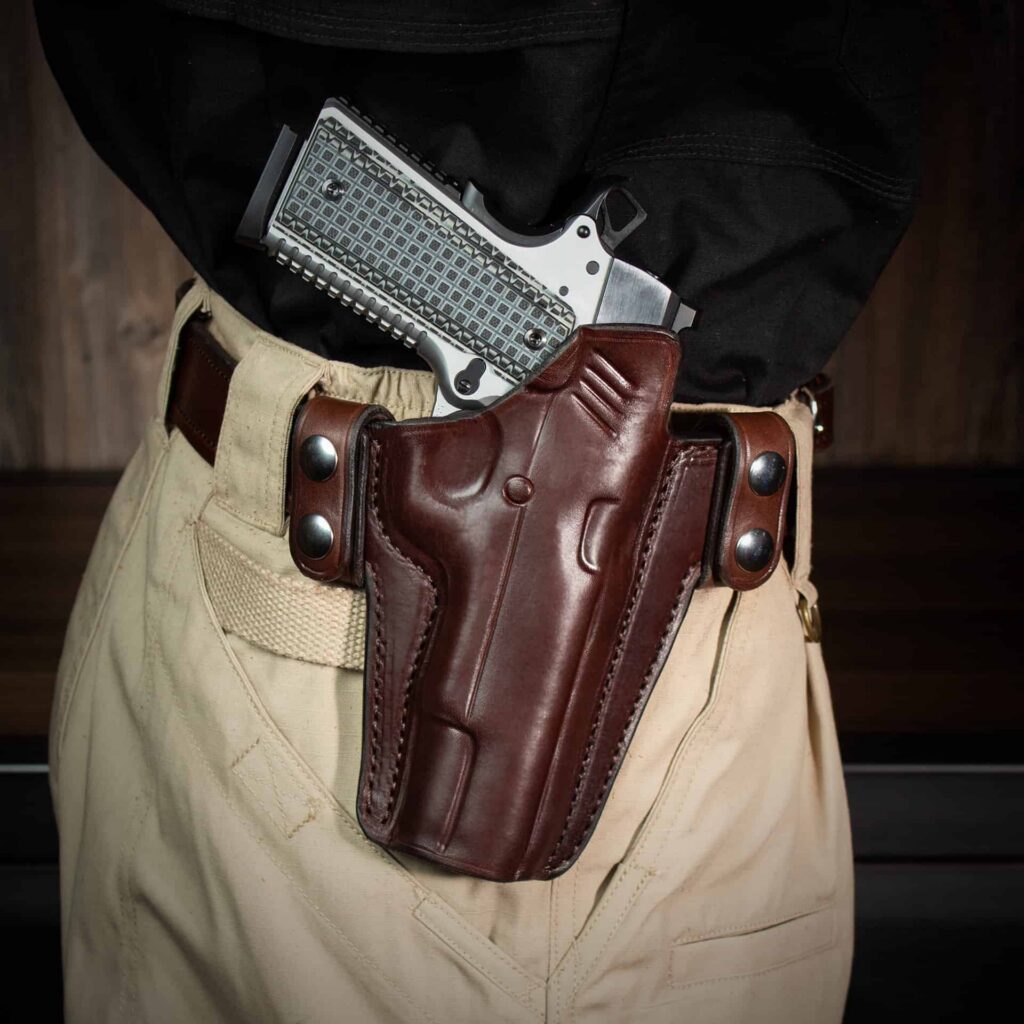
Generally less concealing, but OWB holsters can be a viable option if you wear loose-fitting clothing such as a shirt or jacket. OWB holsters also provide easy access and will typically not apply pressure directly on the body.
Appendix Carry Holsters
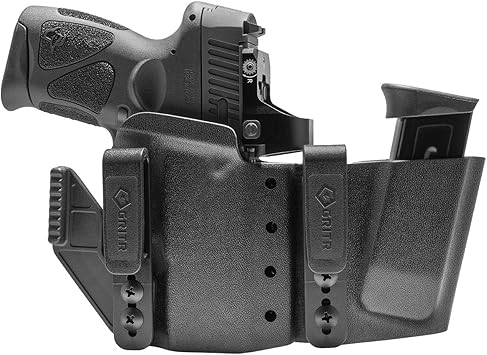
Popular appendix carry IWB holsters allow for extremely fast access. However, for those who are larger due to a larger stomach, this style may need to be positioned carefully, and you should opt for a very comfortable design, since the added bulk from the holster can create discomfort while seated.
We earn a commission if you make a purchase, at no additional cost to you.
10/19/2026 11:44 pm GMT
Shoulder Holster Designs
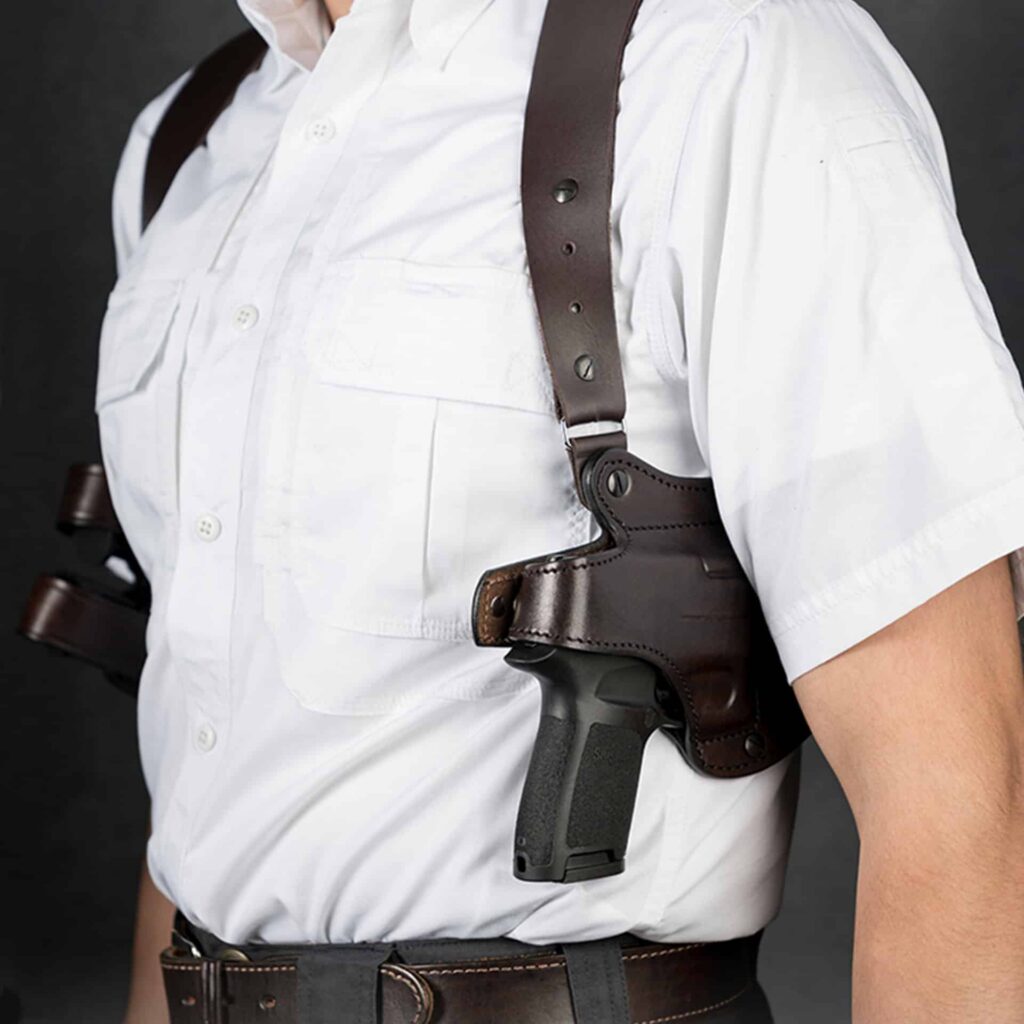
Shoulder holsters distribute the weight of the firearm across the top of your shoulders. Some larger folks find shoulder holsters to be a comfortable way to carry a firearm during prolonged sitting. However, proper covering is required.
Belly Band Holster Designs
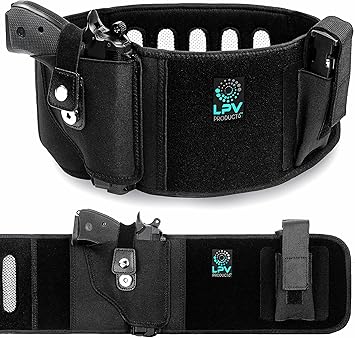
Belly bands are a type of wide, adjustable band that you wrap around your midsection. Because belly bands come in various sizes, they can provide flexibility for carrying a firearm regardless of size and/or position. However, the band may become damp with sweat and is particularly uncomfortable in warmer climates.
We earn a commission if you make a purchase, at no additional cost to you.
10/20/2026 03:47 am GMT
Key Features of the Best Duty Holsters
Regardless of your body type and size, selecting the best duty holsters will require an evaluation of how each feature improves both your comfort and performance.
A Wide Backing Plate or Base: The backing plate on a holster gives a wide area to distribute the weight/pressure of the holster, therefore giving less chance of creating blisters, and/or slippage.
Soft Lining and a Sweat Guard: Using materials such as Neoprene (a soft rubber), Ventilated Foam, etc., can greatly reduce chaffing and prevent sweat/moisture from coming into contact with the gun/skin.
Adjustable Clips: Adjustable clips allow you to adjust the ride height/cant of the holster, allowing you to place the holster where it feels most comfortable for optimal concealment/access.
Retention Devices: Retention devices come in many forms, including adjustable retention screw(s) and thumb break(s). These types of retention mechanisms allow you to control how much friction is put onto your gun while keeping it securely attached until you choose to release it.
Compatibility With Belt Widths: If you are using a larger/heavier belt, then you will be able to get greater support/stability from a holster that is made for that type of belt.
Practical Tips for Everyday Comfort and Concealment
Practical concealed carry tips and tricks for everyday life. Comfort & concealment work together. Here are some practical concealed carry tips from people who have been carrying for years & firearm instructors:
Choose a good gun belt: A gun belt needs to be strong enough to hold your firearm as well as your holster. Most standard belts will sag when you’re wearing a large frame, so it makes it harder to stay comfortable while concealing.
Mind what type of shirts you wear: When choosing what type of shirt to wear for conceal carry, choose one that’s about an inch or two longer at the bottom than you normally would. Also, choose something that has patterns on it. They hide the outline of the weapon better than solid colored shirts. Darker colors are best for this reason, too. If you want to add an extra layer over the top of your shirt for additional concealment, use a jacket or overshirt.
Find out what position is best for you to carry at: Many times, there is more than just one way to carry a weapon. Try each of the three most common ways to see which works best for you: 3 o’clock, 4 o’clock, and an appendix. Each style is very different; however, many duty holsters allow you to adjust how high the weapon sits, so you can experiment with different styles if needed.
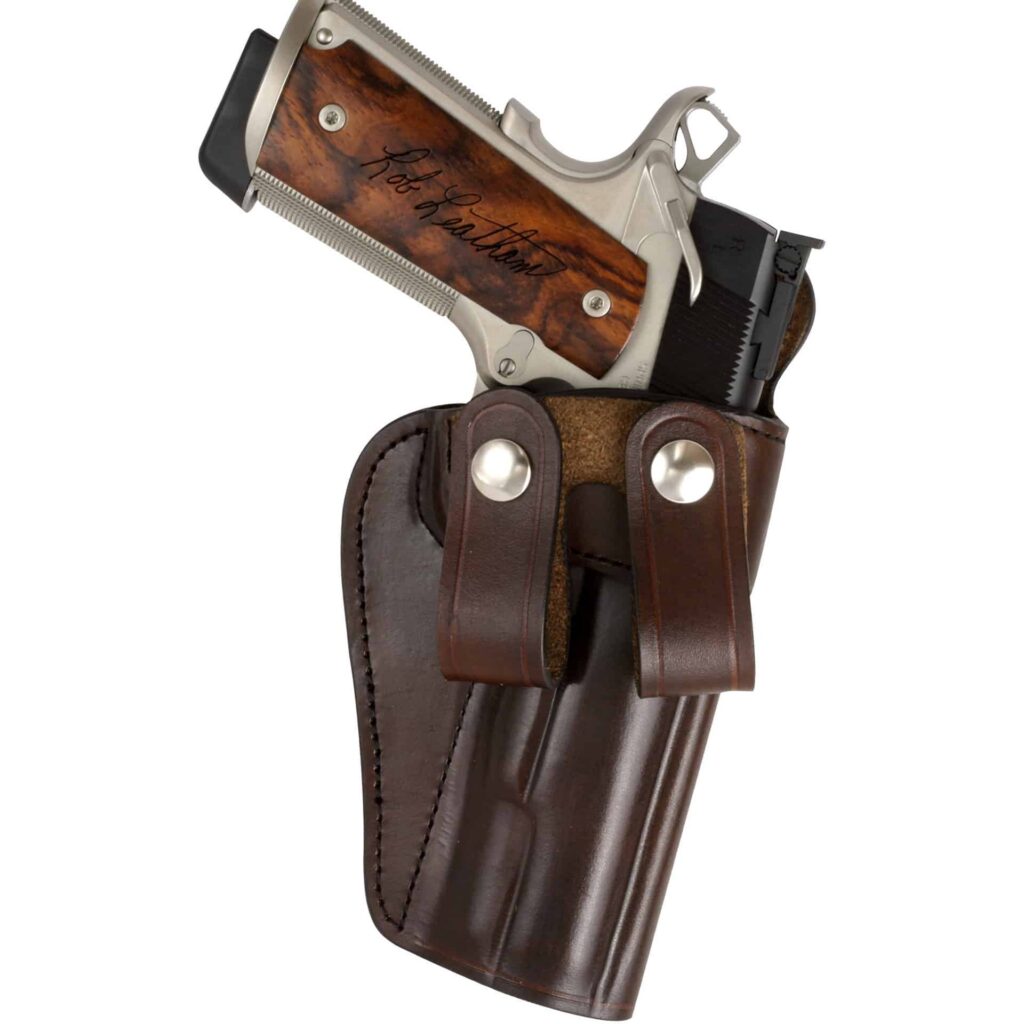
Consider the Material of the holster: While some types of Material such as Kydex, are great for retaining the weapon,n they can also be stiff against the body. Leather and hybrid holsters can provide a softer surface against the skin, especially during long periods of time when worn.
Regular Practice: Regardless of what type of holster you end up using, regularly practicing drawing and re-holstering is important. Large-sized people may need to develop specific techniques for accessing the weapon from whatever location they’ve decided to carry it from, in order to get the weapon out as quickly and safely as possible.
The Role of the Best Duty Holsters in Professional Settings
For law enforcement officers, security personnel, etc., who have to carry a firearm as part of their occupation, the decision about which holster to use has significant implications. In terms of larger-built working professionals, the ideal duty holster will also be capable of meeting the same criteria listed above, but will need to put an emphasis on durability and retention.
Duty holsters are typically exposed to greater amounts of physical stress and potentially life-threatening confrontation than concealed carriers. Duty holsters should provide adequate retention capabilities (i.e., locking mechanism or level II/III retention).
Additionally, many departments and/or agencies have minimum requirements for various aspects of equipment, including holsters. Therefore, it is important to find a holster that meets your individual comfort needs as well as the safety needs associated with your position.
What Experienced Carriers Recommend
Many experienced carriers who wear large frame guns will tell you, is that each of us is different, and may need to try many different holster styles and manufacturers before we find one that fits our needs. That being said, some manufacturers seem to have an edge over others when it comes to producing holsters for larger individuals.
The fact that this article does not endorse a particular product is no reason to dismiss looking for wide, contoured, adjustable holsters and reading reviews written by people who own firearms that are very close in size and shape to your own. Peers will likely encourage you to begin with either a hybrid IWB (Inside Waistband) or high-riding OWB (Outside the Waistband), and then adjust from there based upon your daily routine, the type of clothing you most commonly wear, and your firearm model.
We earn a commission if you make a purchase, at no additional cost to you.
10/20/2026 04:45 am GMT
Finding The Best Safe Firearm Concealment for Fat Guys
Finding the Best concealed carry holster for big guys (and women) isn’t simply choosing the first one you find; it is about discovering a holster that will provide you with a comfortable and safe place for your firearm, as well as an easy way to get to your firearm when needed. A good duty holster will be able to accomplish this by combining all three (comfort, concealment, accessibility) and allow you to perform reliably in either a self-defense situation or while on duty.
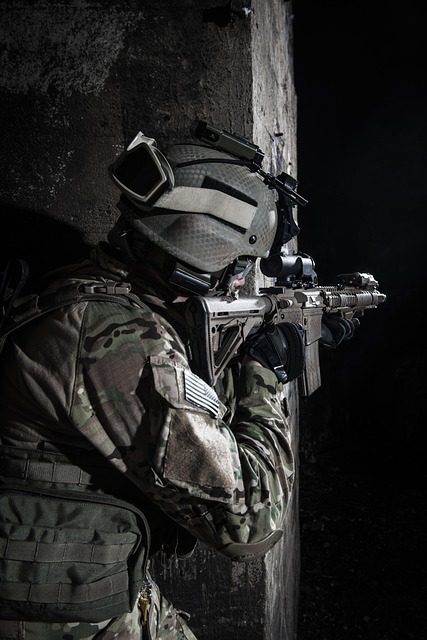
Modern civilian firearms are the product of decades of engineering refinement. And, a significant portion of that refinement traces directly back to military research and development.
When you hold a lightweight polymer-framed pistol, adjust a modular rifle stock, or look through a red dot sight, you are interacting with technology that was likely first conceived, tested, and proven in military environments before it ever reached the civilian market.
This connection between military and civilian firearms is not coincidental. It is the natural result of how innovation works under pressure. Military programs fund research that civilian manufacturers could never afford independently, and the battlefield acts as the most demanding quality-control process imaginable. What survives that process eventually finds its way into the hands of hunters, sport shooters, and responsible gun owners everywhere.
Understanding where this technology comes from helps buyers make smarter decisions, appreciate what they are purchasing, and develop a deeper respect for the engineering that goes into modern firearms.
The Battlefield as the World’s Toughest Testing Ground
No commercial testing environment can fully replicate what military firearms endure. For example, a rifle issued to soldiers must function reliably in the freezing mountains of Afghanistan, the humid jungles of Southeast Asia, the blowing sand of desert environments, and everywhere in between, often without access to cleaning equipment, spare parts, or ideal storage conditions.
This extreme demand created a culture of relentless engineering improvement within military procurement. Every weakness identified in the field became a problem that engineers were required to solve. Every failure in combat had real consequences, which meant that tolerances were tightened, materials were upgraded, and mechanisms were redesigned until they met standards that purely commercial development would rarely demand.
The result is a pipeline of proven innovation. Once a military firearms technology demonstrates reliable performance under the harshest real-world conditions, it becomes a natural candidate for adaptation into the civilian market, where the standards are still high, but the conditions are considerably less extreme.
Optics: From Battlefield Necessity to Everyday Advantage
Perhaps the most visible example of military technology crossing into civilian use is in optics and sighting systems. For most of firearms history, iron sights were the standard for both military and civilian use. That began changing significantly during the latter half of the twentieth century, as military programs invested heavily in improving how soldiers acquire and engage targets.
Red dot sights, holographic optics, and magnified rifle scopes were refined through military contracts and battlefield feedback. The requirements were demanding, optics needed to maintain zero after being dropped, function in rain and fog, hold up to the recoil of repeated firing, and allow shooters to acquire targets quickly under stress.
Civilian shooters today are the direct beneficiaries of that investment. Red dot sights that once cost thousands of dollars and were available only to special operations units are now affordable and widely accessible. Hunters benefit from long-range precision scopes developed with military accuracy standards in mind. Competitive shooters use optics that offer faster target acquisition than iron sights could ever provide.
The practical advantages are real and measurable, better low-light visibility, faster engagement at multiple distances, and improved confidence for users of all experience levels.
Lightweight Materials: Carrying Less Without Sacrificing Strength
Weight is one of the most persistent challenges in military equipment design. A soldier may carry a rifle for hours or days at a time, often alongside substantial loads of other gear. Every ounce removed from a firearm without compromising its strength or reliability is a genuine operational advantage.
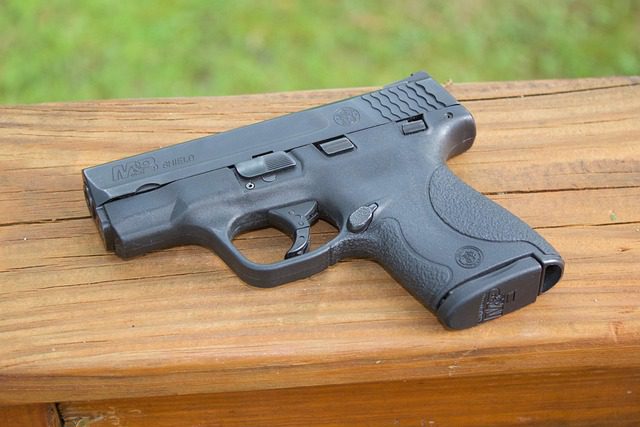
This imperative drove major advances in materials science as applied to firearms. Polymer frames, which are now standard in a wide range of civilian handguns, were developed and refined largely through military and law enforcement procurement programs. High-strength aluminum alloys replaced steel in components where full steel strength was unnecessary. Synthetic stocks replaced wood in rifles, reducing weight while improving resistance to moisture and temperature changes.
The civilian market absorbed these developments quickly. Today, a full-size service pistol may weigh considerably less than its steel-framed predecessors from several decades ago, without any reduction in durability or longevity. Hunting rifles are lighter and more comfortable to carry through the field. Defensive firearms are easier to handle for a broader range of users, including those with smaller frames or less upper body strength. These changes represent genuine improvements in usability, and understanding them is something many trusted firearms dealers help buyers do when evaluating their options in today’s market.
We earn a commission if you make a purchase, at no additional cost to you.
10/20/2026 05:43 am GMT
Modular Design: Adaptability Built Into the Platform
One of the most significant conceptual contributions of military firearms development to the civilian market is the idea of modularity, which is the design philosophy that a single firearm platform should be adaptable to different missions, users, and conditions by swapping or adjusting components rather than replacing the entire weapon.
The military value of this approach is straightforward. A rifle that can be configured with different barrel lengths, stock options, grip configurations, and accessory attachments serves multiple roles without requiring entirely separate procurement and training programs. Soldiers can adapt their equipment to the specific requirements of a given mission.
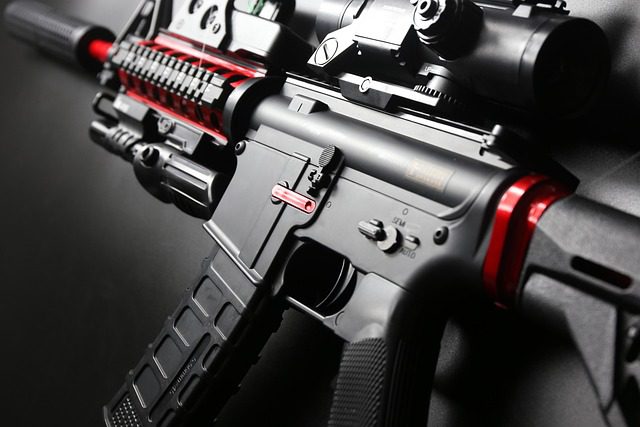
In the civilian market, this same philosophy has created an entire culture of customization. Modern sporting rifles allow users to adjust stock length and cheek weld to fit their body proportions. Handguns with interchangeable grip panels and backstraps can be configured to fit different hand sizes. Accessory rails allow users to attach lights, lasers, and other equipment based on intended use.
For the civilian shooter, this means a firearm that can genuinely grow with them, configured simply when they are new to the platform, and progressively refined as their experience and preferences develop. A hunting rifle can be adapted for different game or terrain. A defensive firearm can be configured specifically for the user’s needs and physical characteristics.
This flexibility, which traces directly to military design requirements, has fundamentally changed how civilian shooters relate to their equipment.
Military procurement does not accept unreliability. A firearm that fails to function when needed is worse than useless, and simply put, is a liability. The testing protocols that military firearms must pass before adoption are extensive, covering thousands of rounds under varied conditions, exposure to environmental stressors, and deliberate attempts to induce failures.
This culture of demanding reliability has shaped civilian expectations in powerful ways. Shooters today reasonably expect their firearms to function consistently across a wide range of conditions and ammunition types, with minimal maintenance. They expect that a firearm purchased from a reputable manufacturer will perform reliably for tens of thousands of rounds over many years of use.
Civilian firearm expectations are largely met because the engineering standards that produce military-grade reliability have been carried into civilian manufacturing. The same metallurgy, the same quality control processes, and in many cases the same manufacturing facilities produce both military and civilian variants of many popular platforms.
For the civilian buyer, this translates to genuine peace of mind, whether that firearm is being used for competitive shooting, hunting, or home defense, the expectation of consistent performance is well-founded.
Safety Improvements Rooted in Discipline and Design
Military firearms culture places enormous emphasis on safety through both mechanical design and disciplined training. The consequences of negligent discharges in military environments are severe, which has driven continuous improvement in both how firearms are designed and how users are trained to handle them.
Modern civilian firearms reflect this emphasis directly. Firing mechanisms with multiple redundant safety features, improved trigger designs that reduce the risk of unintended discharge, and ergonomic layouts that naturally promote safe handling practices all have roots in military and law enforcement development programs.
Equally important is the influence of military training philosophy on civilian firearms education. The fundamental safety rules taught in civilian courses, treating every firearm as loaded, keeping the finger off the trigger until ready to fire, being aware of what lies beyond the targe, are drawn directly from military and law enforcement protocols. These are not arbitrary rules but hard-won lessons encoded into training after decades of real-world experience.
For those looking to deepen their understanding of how these design evolutions have shaped today’s market, there are companies that provide a thorough look at modern firearm categories and their practical applications, a useful resource for buyers seeking informed guidance.
We earn a commission if you make a purchase, at no additional cost to you.
10/20/2026 05:43 am GMT
The Distinction That Matters
While civilian firearms share technology with their military counterparts, they are designed for fundamentally different purposes. Civilian models are built to comply with legal standards, prioritize safe handling for users of varying experience levels, and serve applications like hunting, sport shooting, and personal defense.
The military origins of the underlying technology do not change this distinction. They simply mean that the engineering behind civilian firearms has been pressure-tested in the most demanding environment imaginable before being refined for everyday use.
The Future of Civilian Firearms
The influence of military firearms technology on civilian gun design is deep, ongoing, and largely beneficial to the end user. Better optics, lighter materials, modular platforms, robust reliability standards, and improved safety features, all of these trace at least part of their development to military research and real-world battlefield feedback.
For civilian shooters, this history is worth understanding. It explains why modern firearms perform as well as they do, why certain design features have become standard, and why the gap between military-grade performance and civilian-accessible quality has narrowed dramatically over recent decades. As technology continues to advance, that pipeline from military innovation to civilian benefit shows no sign of slowing down.